
Skip to content
Eli Dupree's avatar, a smiling face with a wizard's hat as a broken version of the 'male' and 'female' symbols.
Welcome to Eli Dupree's website! Eli Dupree is a human who writes stories, games, music, and art. Ze blogs about everything from feminism and neurodiversity to math and computer programming.
Home | Index | Feed iconAtom feed
You can contact Eli by email at:
eli(AT sign)elidupree.com
You will be able to register an account and log in here if your browser supports JavaScript and some form of local data storage. You appear to be using a browser that does not support JavaScript.

You are not logged in.

You will be able to register an account and log in here if your browser supports JavaScript and some form of local data storage. You appear to be using a browser that does not support JavaScript.

Username:
Password:
Duration:
Usernames must be between 3 and 32 characters, and can only contain letters, numbers, and underscores. Passwords must be at least 8 characters long.
Username:
Password:
Retype password:
Write "I am not a bot":
Login duration:
Posted at UTC 2011-10-09 20:51:08
Eli_Dupree says:
Eli_Dupree's avatar

Self-study

This post is to give you some insight into how my creative process works!

So... Instinct vs. intellectual understanding. Complex ideas are great. The only trouble with complex ideas is that you can't keep the whole idea in your conscious mind at the same time. So you need to just rely on the knowledge you already have, so you can build on it. The things you're thinking about actively, I call intellectual understanding; the things you already know, that you can use without thinking, I call instinct.

Of course, it's a good idea to go back and examine your instincts, from time to time.

I drew my last comic mostly by instinct. Especially the panel borders. I didn't think What do I want this line to express and how do I accomplish that?; I just thought Hmm, this line doesn't look right... *redraw* ehh... *redraw* ooh, this works!. In short, I had an instinct for what I wanted, but I didn't intellectually understand exactly what I wanted.

I love understanding things, so after I drew the comic, I went back and analyzed my own work! Here are some of my thoughts:

  • The flared border at the bottom of the second panel echoes the powers Tritia's using in that panel. It makes the concept clear that Tritia is having an effect on stuff, especially with the way it stabs into the larger image below.
  • The way the last panel is drawn in front of the others give it more emphasis (which is good, because part of the joke is the fact that such a mundane statement gets so much emphasis). It also puts it slightly outside the flow of the story, which is good, because the main flow is the fight with Tritia.
  • The way Jeva's katana ignores panel borders. It's a bit of a running joke to draw the katana above things that it would normally be drawn below, but it also works for me here – in the first panel, it helps capture the interrupted-ness of the continuation from the previous page, and in the last panel, it helps accentuate Jeva's droopy-ness. If it was in the panel, I'd have to move the speech bubble up, and anyway, having things break the normal rules usually helps emphasize them. Oh! And I hadn't even thought about the fact that putting the speech bubble at the bottom, curving down, added to the overall effect of that panel.
  • Some other things didn't work so well. For instance, there's no good reason for Sam's speech bubble to be all the way at the right side; it confuses the flow a little. That's something I can keep in mind when watching my habits of where I put speech bubbles. I also should have found a way to indicate more motion in the crevices (bits still falling off, perhaps?), to make it clear that Tritia just dug them. As it stands, you might think that they were there the whole time.

Anyway, one of the interesting things here is this: I'm finding it just as productive to study my own work as to study someone else's. That makes sense right now, because I've read a lot of comics already, but haven't written very many of them myself... yet!

– Eli
Tagged in posts about writing, posts about visual art.
Direct link to this post | You could reply if you had Javascript and local storage ("cookies") enabled
Posted at UTC 2011-09-05 22:16:43
Eli_Dupree says:
Eli_Dupree's avatar

Prose vs. graphic narration

So, I was thinking about prose and graphic storytelling. Instead of me writing about a bunch of principles and abstractions and stuff, how about we go straight to an example? Here's a line of prose:

I knocked. No answer. Let myself in anyway. Where was he?

I generally think that graphic storytelling can express ideas much more quickly, so I deliberately constructed that line to be the opposite: Something that prose can express more quickly. Let's look at how we might write that in pure images:

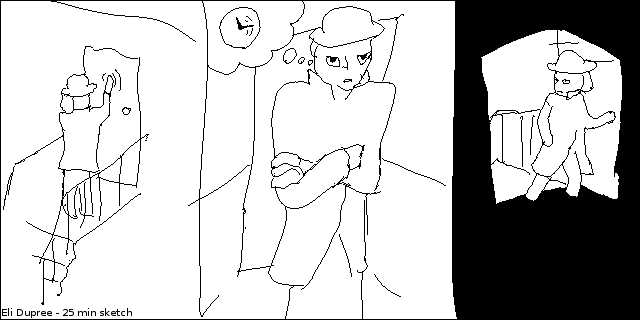
Image: Three panels. The first panel shows a person knocking at a door. The second shows zem waiting impatiently, thinking about the time. The third shows zem entering through the door, looking around. At the bottom left is a note that says 'Eli Dupree - 25 min sketch'

Those three panels might take up about a third of a page, if we're going to publish this as a print book. The line of prose, on the other hand, takes about, what, a twentieth of a page? Sure, a reader will be able to take in the images faster than they would read a third of a page of text, but still, the single prose line here much more compact and concise.

On the other hand, the prose glosses over a lot of details that we get to see in the images. The graphic narration tells us about the style of our main character's coat, zir attitude about being forced to wait, and a lot of other things. If I got the subtle body language right in the second panel, it tells us that it's chilly outside. So the graphic narration really tells us a lot more information, even if it takes up a little more space.

(The graphic narration also doesn't tell us the gender of the person the main character is seeking. To me, this is an advantage of graphic narration.)

We can also combine the two forms, like this:

Image: The third panel of the first image, but with the prose line written in narration boxes: 'I knocked. No answer. Let myself in anyway' at the top, and 'Where was he?' at the bottom.

That conveys all the information from the prose line (obviously), and also most of the information from the three-panel image above, and it does it in only one panel. It also has an interesting attribute: It repeats information. You don't need the text to tell you that the person is going through a door. With the text there, you don't need the image to tell you that the person is going through a door. Either one does the job just as well.

In prose fiction writing (and playwriting and screenwriting), one of the standard principles is that redundancy is bad. You shouldn't explain something more than once, because after the first time, the reader is going to know what it says and be bored by it. And it's even worse in theatre and film, where the reader can't skim over dialogue ze doesn't need to hear.

But that isn't necessarily true in graphic narration. Saying the same thing twice is bad in prose, because in prose, everything you say is part of the narrative flow. The reader can't read two lines at once, so everything you write is going to take up some amount of the reader's time, so you have to make every detail count.

Not so in graphic narration, where the reader can perceive an entire image at once. I mean, think about the most trivial example: I drew the coat in every panel. After the first panel, you know the person is wearing a coat, so if I was trying to eliminate all redundancy, I would not draw the coat in the later panels. But that's silly. The repetition of the coat is good redundancy, because it doesn't take the reader any extra time to see the coat in the later panels – in fact, it's actually quicker to glance over the same coat than to see something different. So basically, the rule is that if something takes up space in the narrative flow, you try to eliminate redundancy, but when you can sneak in extra information without disrupting the narrative flow, you should repeat yourself as much as possible! (Well, not if it prevents you from doing other cool stuff. But you probably get the idea.)

So, in short, graphic storytelling is a much more condensed format – you can convey a lot more information without taking any more of the reader's time. So why doesn't everybody do it?

OH YEAH, BECAUSE IT IS ACTUALLY KIND OF HARD.

See the little note at the bottom of the three-panel image? Eli Dupree - 25 min sketch? It took me 25 minutes to draw that. And writing the prose line took about 25 seconds. Granted, I'm not very experienced at this right now, and I'll speed up with practice, and in any case it would be quicker to draw if it was an established character of mine rather than someone I had to invent on the spot, but anyway, the point is: Graphic stories are quicker to read, but they're much slower to create.

There's a reason I picked the phrase condensed format: In both prose and graphic storytelling, you start with the same set of cool ideas, but with graphic storytelling, you cram those ideas into a smaller package that the reader can consume more quickly and easily.

And that gets me to one of the really annoying questions about The Purpose Of Art. Because, like, I want to produce the best work possible. But I also want to not spend my whole lifetime on one piece. Because I could do a lot more than that if I just wrote things that weren't quite as good, but that I could write more quickly.

And that's a question that I don't have an answer to!

Incidentally, this post took about an hour to write, in addition to the sketching time.

– Eli

Tagged in posts about writing, posts about visual art.
Direct link to this post | You could reply if you had Javascript and local storage ("cookies") enabled
Posted at UTC 2011-08-20 03:44:19
Eli_Dupree says:
Eli_Dupree's avatar

A little update

I still haven't been doing much for a while - mostly playing online games, watching videos, and so forth. Oh, and running a quirky Mafia variant on an internet forum - you can check it out over here on the XKCD forums if you're into that sort of thing. My inactivity has a lot to do with the fact that it's late in the summer, it's hot all the time, and I haven't been talking to other people too much. (Getting at least a little interaction with other people helps me, because it stimulates my mind and gives me new ideas.) I'm going to be going back to college relatively soon, too, and that's discouraging me from getting into projects a bit, even though I still have about three weeks left.

That said, I've still got a couple of projects running. I'm working on them occasionally, it's just that they're not taking the majority of my time.

One of them is that I'm learning more Javascript, so that I can make cool online games and utilities. Check out this extremely-unfinished game for an example of what I'm messing with. (EDIT: That's a link to the version that I wrote at the time of this post. This is a link to the current version, which I will keep messing with.)

The other is this: Since I'm blocked on the graphics editing software project, I've started just drawing stuff in an existing graphics program (namely GIMP). Here's something I randomly sketched a few days ago:

Image [see below]

(That's an image hosted on an external site. Tell me if it breaks. A transcript is in a footnote.1)

I've also started sketching characters for a fairly absurd short comic (3-4 pages, probably). I might end up drawing that in the next week or two.

Speaking of posting comics here on this website, that's yet another thing that I'm going to need to do programming work for. It's not a problem if I just stick them in blog posts for the moment, but it'd be nice to have a more formal way of presenting them. I'm still planning to post that novella, too – I've edited it as much as I need to, and now the only thing stopping me from posting it is that I haven't been feeling like doing the technical end of things (and, again, I want it to be presented more nicely than just sticking it in a blog post).

Anyway, there's an update for you. Things will probably get more interesting when I head back to college – I'll try not to get so busy that I don't have time to blog, heh heh.

– Eli

Footnotes:
  1. Transcript of the above image:

    Text: What shall I draw? thought I.

    Picture: A cartoon of myself, with an excessively cheerful expression, thinking: Maybe something DARK & DISTURBING?

    Picture: A gaunt face drawn in white on a black background, surrounded by orange streaks. Its thoughts are written messily: I DON'T KNOW WHY I'VE BECOME LIKE THIS. I AM SO COLD, COLD!! I DON'T NEED ANY HELP!!

    Text: What sex is our friend the pyromaniac? I find it easier to read zem as male, but is the face actually characteristically male or is it just that I'm more familiar with that exaggerated gauntness on male characters, while our society makes people draw female people in pristine condition always?

    back
Tagged in posts about gender, posts about visual art, posts about computer programming.
Direct link to this post | You could reply if you had Javascript and local storage ("cookies") enabled
Posted at UTC 2011-06-27 05:10:09
Eli_Dupree says:
Eli_Dupree's avatar

A few concepts I need

I made progress again on my graphics editing stuff; I have a program that takes tablet input and converts it into individual lines/strokes. That task was surprisingly easy; once again, I'm a bit unsure of what to do next.

So I just set myself a specific task: Create the software that I would want to use to write People Are Wrong Sometimes if I'd written it with this instead of on paper.

Which of course raises the question What do I need for that?. So I looked over People Are Wrong Sometimes from a conceptual perspective, turning the question into What are the things in it?.

  1. Lines (straight or curved), of varying colors.
  2. Fields bounded by straight/curved lines, of varying colors.
  3. Text

I already have the concept of lines.

One interesting thing that I notice about the lines is that they almost never cross; usually, one line is cut off by another (e.g. panel borders cut off the image, speech bubbles obscure objects in the panel, and some objects or people are in front of others...). In my pencil and pen drawings, I had to carefully end each line where the next began. In my computer programs, I should have a way to automatically have one line cut off another, which means I need the concept of where lines cross. And, on a related note, I should have a way to automatically detect when I've surrounded a region completely, so that region can be filled with color.

For the moment, I'm going to ignore the text. I like the way I used a variety of different typefaces in People Are Wrong Sometimes, but I don't like the way I was relying on pre-existing typefaces that didn't necessarily fit the overall visual style of the piece, and I don't like the fact that I didn't have precise control over the size and flow of the text. On the other hand, I definitely wouldn't like to write all the text myself; my hands hurt if I write for long periods of time, and my handwriting isn't very good. I've heard that some artists draw their own typefaces (where since you only have to draw each letter once or twice, you can spend a lot of time getting it right); I might want to do that, but it's something for later.

In the writing process of People Are Wrong Sometimes, I drew a lot of sketches; I sketched out everything in pencil first, with a lot of experimenting and erasing, then drew over it in pencil to decide exactly what I wanted, then drew over it in pen and erased the pencil marks before scanning it. In the computer, I'll need that same leeway to draw and redraw, so I need a concept of selective erasing. And I'm going to need to be able to erase one line without erasing another that's very close to it. Internally, the lines are all going to be numbered, but in my user-interface, I'm going to need a way to refer to them without typing in numbers all the time. Maybe that could be accomplished just by zooming in (and having a mode1 where I use the tablet-pen as an eraser.)

I'm also going to want a really sophisticated undo system, for when I make mistakes – INCLUDING mistakenly undoing things. My current plan is to store a complete record of all operations (like drawing a line or changing a line's color) on an image, including undo operations, and have it be theoretically possible to re-construct the image from nothing just by going through all the operations. And have them be discrete/separable enough that you could go back and undo individual long-ago operations without having it interfere with the rest of the chain. But of course, doing that would be simply adding an undo instruction to the end of the chain. The advantage of this system is that it makes me automatically able to go back to any version of the image, even dead-end versions that I didn't like at the time and undid. I'm going to want to have the operation-log be displayed on-screen, along with the actual image, and have various features that let you mess with the image from that perspective.

I also need to be able to move, zoom, and rotate the drawing field.

Some things that I could have used, but (deliberately) didn't use in People Are Wrong Sometimes are: Continuous shading, texture/pattern, significantly-varied line weight... it was, very explicitly, constructed out of the concepts of line and field, rather than being constructed as marks on paper. I like drawing in that way; remind me to make a post about how drawing can be done from an abstract/conceptual communication perspective, just as much as writing can.

– Eli

Footnotes:
  1. And when I say mode, I probably mean a key that I hold down while drawing. Holding a key with one hand while drawing with the other might be inconvenient, but it's a lot less inconvenient than accidentally leaving the mode on and then trying to draw a real line. The book The Humane Interface calls hold-down-a-key modes quasimodes, and recommends them highly. back
Tagged in posts about visual art, posts about the graphics editing project.
Direct link to this post | You could reply if you had Javascript and local storage ("cookies") enabled
Posted at UTC 2011-06-11 07:10:37
Eli_Dupree says:
Eli_Dupree's avatar

Introducing the graphics editing project

This is going to be one of those posts that make me think Why am I writing a post about this instead of doing it?!. But it's late at night and I'm not really going to get anything done before the morning, so I might as well go ahead and write this up.

So, I wrote a graphic short st– No, wait, I'm going to tell this in chronological order, starting from way back in the beginning. We could have a long argument about where the beginning really is, and whether it's really a net or lattice rather than a linear story that starts at a single beginning point, but we're not going to do that, because I'm the one telling this story, and I've picked one beginning point that I like best.

It begins with me dorking around with the images from an old computer RPG called Sword Dream. Or maybe it was Yipe!. How old am I – ten? Anyway, it was basically me taking images and drawing over them or recombining them. I wasn't very good at it, but it wasn't hard to do things like copying the head of a monster to make a monster that had two heads, or stuff like that. I had an idea of what I wanted to accomplish, but my tools didn't let me accomplish that. I was using old Mac software – GraphicConverter and ClarisWorks. Later, I started using the GIMP, but it wasn't much of an improvement, because it had the same basic problem: It wasn't a seamless extension of my underlying wills and desires! There's a saying, Only a bad worker blames their tools1, but that saying was written by people who didn't have computers. Why should I ever do work that my computer can do for me? If you know me, you know that I insist on automating everything that can possibly be automated.

Shuffle the timeline around a bit because I don't remember what order this next stuff comes in. I spend lots of time drawing stuff in school – doodling, you might call it. I drew a lot of dragons. I mostly drew them in the same style – bold lines and shapes, little to no shading. When I did draw pictures where I used shading more, people told me they looked better, because they were more realistic, but I didn't like them. What's the point of being realistic? If I wanted a realistic picture, I'd take a photograph. No – the goal of art is to produce something that's better than realism. It's to project our wills and desires through the medium and onto our audience. (To break the narrative a bit, look at my avatar on this site – the circular face with the yellow background, the broken-off pieces, and the wizard's hat. There's not a realistic image in the world that could convey the ideas that image conveys.)

Meanwhile, I go through some more computer games, most notably Spiderweb Software's Blades of Exile, and finally came to rest at the modern Free-and-open-source game, Battle for Wesnoth. (You'll probably hear more about my exploits in the BfW community in some other posts, too; I've committed a huge amount of time to it.) BfW had an active community of artists, and I learned a bunch of stuff from them. I tried my hand at making graphics for the game, but I was constantly frustrated by the software I had available to me. I actually liked ClarisWorks better than the GIMP for sprite editing2, because it had a simpler user interface, without all the fancy controls of the GIMP. But I was picking the lesser of two evils. At some point during this time period, I decided that I should write my own sprite editing software, tuned to that specific task instead of being a general-purpose graphics editor like the GIMP. That's not what I'm doing now; I will probably never do that, because sprite art is a horrible kludge that only exists because of the limited resolution of computer monitors. Moving on...

Fast forward about three years. I've taken some serious art classes in high school, which made me pretty good at drawing things in a photo-realistic way, which is nice even if it's not the most important skill to have.3 It's my third semester of college. There are two cool creative writing courses offered in January. One of them is a prose memoir course taught by a person who everybody thinks is the coolest creative writing professor ever. The other is course about the graphic novel. The first class fills up very fast, and I don't want to compete for a slot in it, so I sign up for the second. AND THEN MY FATE IS SEALED.

During January, I write the graphic short story People Are Wrong Sometimes (that's a link to where it's hosted on my old website), and I think, Why the hell didn't I get into this medium earlier? This is the perfect medium for me – the way I see it, the essence of a work of art is to effectively express an interesting idea, and a graphic narrative combines the abstract expressiveness of language with the instant expressiveness of images, resulting in a storytelling mode that can express ideas so fast that it can almost do justice to the overflowing supply of ideas that's inside my head.

There's just one catch. It takes frickin' ages! To draw that story, I sketched it in pencil, then drew over it in pencil, then drew over it in pen so that it would come out more clearly to the computer, then scanned it into the computer, then touched it up, then colored it in the computer. And when I colored it, I had to manually separate the lines from each other. This is a tragedy. All of those things were possible to automate, and therefore, they should have been automated.

So I'm going to automate them now.

First, a pencil? Seriously? Why would I ever draw something on paper, which has the unique property of being unable to be analyzed and manipulated at the slightest thought, when I could draw in raw data? Step one of my automation is to get a graphics tablet – a device that lets you draw and have your hand movements be immediately translated into computer data. There's no reason for me to ever deal with physical media in the first place, and having the computer record my drawing means that I can easily mark which lines are which, rather than having to manually separate them afterwards. Of course, this all means that my first task is to do super blitz research on the tablet market and how I can get a bargain on one.

Meanwhile, I need to research the underlying computer format of the tablet input. Or, at least, I need to find other people's code that can accept the input, so that I can use it for my own work. And I also need to learn more about how to read and write existing image file formats.

Once I have a tablet and figure out how to take input from it, it's just a matter of4 experimenting with different ways of processing that information until I have ones that are near-perfectly in tune with my internal ways of understanding how I produce art. And creating internal data structures that I can easily manipulate and change when I decide I want to restructure my stuff. This is all going to sound a little abstract until I actually get started on doing it, but trust me, once I get going, I will have awesome powers. AWESOME POWERS.

– Eli

Footnotes:
  1. Okay, that's not the original saying, but I think it's nicer when we don't use sexist and classist language. back
  2. Oh by the way, a static 2d image used by a computer game is called a sprite. back
  3. At the time of this writing, you can see some of my work from one of those classes at this page of my old website. back
  4. And I make it sound so simple! It is not simple; I just happen to be really, really good at getting my ideas straight, which makes this step the one that I'm most confident about doing well, even though it's probably the most difficult step in abstract terms. back
Tagged in posts about visual art, posts about the graphics editing project.
Direct link to this post | You could reply if you had Javascript and local storage ("cookies") enabled